Diploma Courses After 10th: Polytechnic Options, Duration and Scope
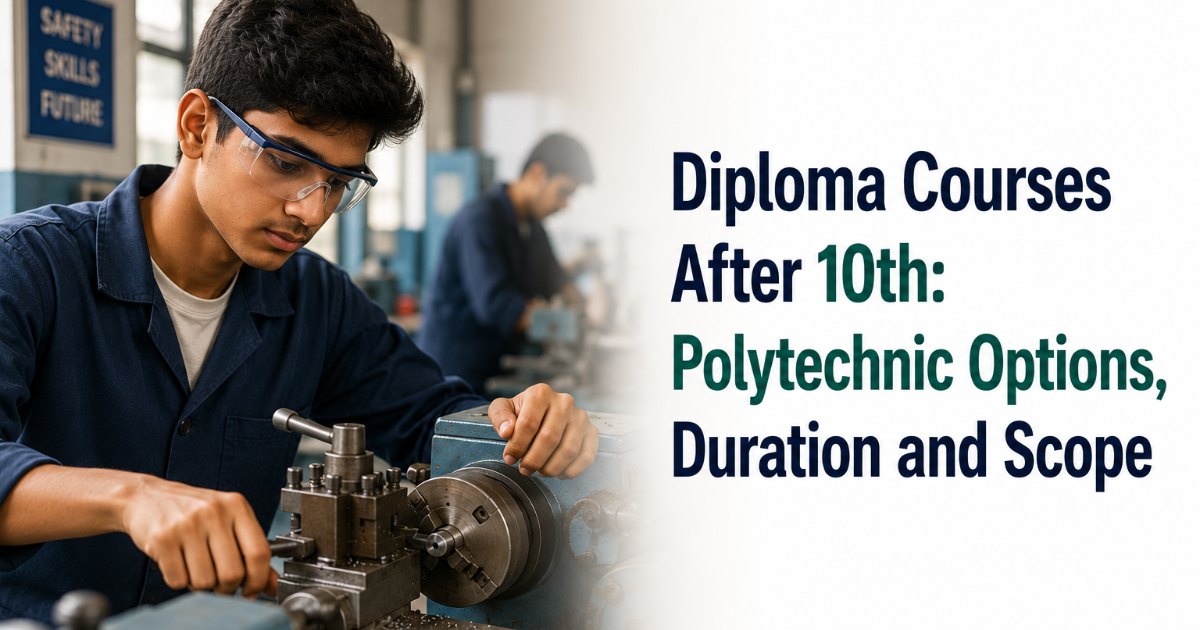
If you have just finished Class 10 and want a faster, more practical route into a career than the usual 11th-and-12th path, diploma courses after 10th are almost certainly what you are looking for. They let you start technical, job-focused study two years earlier — and, importantly, they can still lead all the way to an engineering degree.
But most pages on this topic just dump a long list of course names, which is the least useful way to help you decide. This guide does something different. It explains what a diploma after 10th actually is (and how it differs from an ITI), the main polytechnic branches you can take, how long a diploma runs and how admission works state by state, and the single biggest advantage — lateral entry into the second year of a B.Tech or BE degree. It also gives you an honest three-way comparison of your after-10th options, so you can see where a diploma fits against an ITI and against simply staying in school. Every framework fact below is grounded in the official AICTE structure, not repeated from other blogs, so that by the end you can choose the diploma that genuinely fits your aptitude and your goal.
What diploma courses after 10th actually are
When people search for diploma courses after 10th, they are almost always looking at the polytechnic route. The flagship option is the Diploma in Engineering & Technology — a technical programme recognised by the All India Council for Technical Education (AICTE) and awarded by your State Board of Technical Education (SBTE). It is offered at institutions called polytechnics, and it is designed to take a Class 10 pass-out and turn them into an employable junior engineer or technician in a specific branch.
What makes a diploma after 10th attractive is its balance. It is more academic and broader than a single-trade certificate, yet far more practical and career-focused than two more years of general schooling. You choose a branch — civil, mechanical, electrical, computer engineering and so on — and study it in depth, with a strong mix of theory, laboratory and workshop practice, and often an industry component. Because the qualification is a recognised technical diploma rather than only a trade certificate, it opens a wider set of doors afterward, including the option to continue to a full degree. That combination of an early start, real technical depth and an onward path is what sets diploma courses after 10th apart from the alternatives.
Talk to a CourseLane advisor — free, and no obligation.
The main diploma after 10th: the polytechnic engineering diploma
Of all the diploma courses after 10th, the polytechnic Diploma in Engineering is by far the most common and the most valuable. It is typically a three-year programme, delivered across six semesters, and its entry qualification is a pass in Class 10. Some states and institutes offer variants — a lateral or part-time diploma, or a programme with an integrated industry semester — but the standard full-time polytechnic diploma is three years.
The reason this diploma matters so much is what it certifies. An AICTE-recognised Diploma in Engineering is an accepted technical qualification for junior-engineer and technician roles across government and industry, and it is the qualification that unlocks lateral entry into a degree. In other words, it works both as a standalone employable credential and as a stepping stone. This dual nature is exactly why so many students choose a diploma after 10th rather than waiting: you can enter the workforce at 18-19 with a real technical qualification, or you can carry that diploma straight into the second year of a B.Tech — and you keep both options open until you decide. Few routes after Class 10 give you that flexibility.
Popular diploma courses after 10th, branch by branch
Because a diploma after 10th is defined by its branch, the branch you choose shapes both your study and your career. Here is a snapshot of the most popular polytechnic engineering diplomas and where each tends to lead:
| Diploma branch | Core focus | Common direction after |
|---|---|---|
| Civil Engineering | Construction, surveying, structures | Site/junior engineer, lateral entry to B.Tech Civil |
| Mechanical Engineering | Machines, manufacturing, thermal | Technician, maintenance, lateral entry to B.Tech Mechanical |
| Electrical Engineering | Power, machines, wiring, control | Electrical technician, PSUs, lateral entry to B.Tech |
| Computer Science/Engineering | Programming, networks, systems | IT support/junior developer, lateral entry to B.Tech CSE |
| Electronics & Communication | Circuits, communication, embedded | Electronics technician, lateral entry to B.Tech ECE |
| Automobile Engineering | Vehicles, engines, servicing | Automotive roles, lateral entry to a degree |
This is a representative sample, not the full list — polytechnics also offer branches like Chemical, Mining, Architecture Assistantship, Interior Design and more, and some non-engineering diploma courses after 10th exist too (certain vocational and paramedical diplomas), though several health diplomas such as D.Pharm require Class 12, so always verify a specific course's entry rule. The point is that the branch, not the word 'diploma', decides your path — choose it around what you enjoy and where you want to end up. You can compare specific polytechnics and the branches they offer on the CourseLane college lists.
Diploma vs ITI vs staying in school: the honest comparison
The most important thing to understand about diploma courses after 10th is how they differ from the two alternatives, because these routes are often confused. Here is the honest three-way picture:
- Polytechnic diploma — a three-year, AICTE-recognised Diploma in Engineering from a State Board of Technical Education. Broader and more academic than a trade, and it unlocks lateral entry to a degree. Best if you want technical depth and keep the degree option open.
- ITI — a shorter (usually one-to-two-year) trade certificate under the Directorate General of Training, focused on a single skill like electrician or fitter, leading quickly to employment. Best if you want the fastest route to a specific job. The full process is covered in our guide to ITI admission.
- Staying in school (11th-12th) — the general academic route, keeping open college degrees across science, commerce and arts. Best if you are unsure of your direction or aiming at a route that needs Class 12, like many degree entrance exams.
None of these is universally 'better'; each suits a different student. A diploma after 10th sits in the middle — more depth and more onward options than an ITI, more practical and career-focused than two more years of schooling. If you are still weighing the school route, our guide on how to choose a stream after 10th is a useful companion.
How admission to a diploma after 10th works
Admission to diploma courses after 10th is run state by state, through each state's Directorate of Technical Education or its polytechnic admission body, so the exact process depends on where you apply. Broadly, states use one of two approaches. Some admit purely on Class 10 merit, preparing a merit list from your board marks. Others conduct a state polytechnic entrance test — for example JEECUP (UPJEE-P) in Uttar Pradesh, POLYCET in Andhra Pradesh, and various other state DET or CET examinations — and admit on the rank in that test.
The common shape is familiar: you register on the state's official polytechnic admission portal, fill in your Class 10 details (and sit the entrance test where one applies), choose branches and institutes in order of preference, and are then allotted a seat through counselling before reporting for document verification and fee payment. Because the method and the calendar differ by state and change each year, the reliable instruction is to check your own state's official technical-education portal for the current process, dates and whether an entrance test applies, rather than assuming a single national rule. Getting the state-specific process right early is the practical key to securing a good branch and institute.
The biggest advantage: lateral entry into a degree
If there is one reason diploma courses after 10th are worth serious consideration, it is lateral entry. A student who completes a polytechnic Diploma in Engineering can gain direct admission into the second year of a B.Tech or BE degree, skipping the first year entirely. Under AICTE norms, this lateral entry is offered on supernumerary seats — up to 10% of the sanctioned intake — reserved for diploma holders, a provision in effect from the 2019-20 academic year.
The significance of this is easy to miss. It means a diploma after 10th is not a lesser or dead-end path: it can lead to exactly the same engineering degree as the conventional Class 12 plus entrance-exam route, just reached differently and often more cheaply. A student can do the three-year diploma, then two more years via lateral entry, and emerge with a full B.Tech. Admission to these lateral-entry seats is usually through a state lateral-entry examination or counselling, so the details are again state-specific. But the principle is what matters when you are choosing after Class 10: a polytechnic diploma keeps the degree firmly within reach, which is precisely what makes it more than a shortcut to a job.
What a diploma after 10th costs
Cost is a fair part of the decision, and here diploma courses after 10th tend to compare well. A government or state polytechnic diploma is usually quite affordable — often only a few thousand to a few tens of thousands of rupees a year — while private polytechnics and self-financing institutes charge more, and fees vary by state, branch and institute. Because these amounts change every admission cycle and differ widely between government and private colleges, treat any figure you see quoted elsewhere as indicative only, and verify the current fee on the institute's own page or the CourseLane college lists before you commit.
Set against that modest cost is a genuine return: an employable technical qualification in three years, plus the option of a degree through lateral entry at a lower overall cost than the full five-year school-plus-degree route. For a student who is reasonably sure they want a technical career, that value is one of the strongest arguments for a diploma after 10th. As always, the worth of the qualification comes from the branch you choose and the effort you put in, not from the diploma label alone — so weigh the affordability alongside your genuine interest in the field.
⚠️ Fees are indicative, not quoted. They vary by college, category, quota (government vs management seat), state and admission year, and are revised every cycle. Always confirm the current fee directly with the institution before deciding — CourseLane does not guarantee any figure here.
Career scope after a diploma
The scope after diploma courses after 10th runs in two directions, and both are real. The first is employment: a diploma holder can take up junior-engineer, technician, supervisor and site roles across construction, manufacturing, power, electronics, IT support and the automotive sector, and diploma qualifications are recognised for many technician posts in government departments and public-sector undertakings. This early employability — entering skilled work at 18 or 19 — is a major draw.
The second direction is further study, chiefly the lateral-entry route into a B.Tech or BE already described, but also specialised advanced diplomas and, after a degree, postgraduate options. Many students use a diploma exactly this way: work for a while to gain experience and earn, then return to complete a degree, or move straight into the second year of one. The honest summary is that a diploma after 10th is rarely a ceiling — it is a flexible base that supports both an early career and a later degree. Which of the two you emphasise is a personal choice, and it is worth deciding your rough intent early, because it can shape the branch and the institute you should pick. For a fuller look at how a diploma stacks up against a full degree, see our comparison of a diploma vs a degree.
How to choose the best-fit diploma after 10th
With the options clear, choosing among diploma courses after 10th comes down to a few honest questions. First, do you want a technical, hands-on career rather than a general academic one? If yes, a diploma fits; if you are unsure, staying in school for 11th-12th keeps more doors open. Second, which branch matches your aptitude and the jobs around you — civil, mechanical, electrical, computer, electronics? The branch shapes your work far more than the diploma name. Third, do you intend to stop at the diploma or continue to a degree through lateral entry? Your answer influences which institute and branch make the most sense.
Weigh those against the routes, the state admission process and the costs above, and compare specific polytechnics on real data before you commit. If you are torn between a polytechnic diploma, an ITI trade and staying in school, structured career counselling can help you match your aptitude and goals to the right path. The best-fit diploma — the branch aligned with your strengths and your plan, whether that plan is early employment or a degree — will always serve you better than the one that merely had seats open. Because rules, dates and fees differ by state and change each year, always confirm the current details on your state's official technical-education portal before you apply.
Sources & official references
The figures and rules above are drawn from official Indian education authorities. Always confirm the latest details on these sources before you decide:
How CourseLane can help you decide
Choosing well comes down to finding your best-fit degree course. Our career counselling page sets out the options for matching your interests and aptitude to the right courses, and you can compare colleges and indicative fees on officially-sourced data across the CourseLane colleges directory.
Written and fact-checked by the CourseLane Editorial team and reviewed by the CourseLane Research Team. CourseLane sources figures from official authorities such as NIRF, AICTE and UGC, labels indicative ranges clearly, and never fabricates data.
Talk to a CourseLane advisor — free, and no obligation.
Frequently asked questions
What are the best diploma courses after 10th?
The most valuable diploma courses after 10th are the polytechnic Diploma in Engineering branches — Civil, Mechanical, Electrical, Computer Science/Engineering, Electronics and Communication, and Automobile — because they are AICTE-recognised, employable and allow lateral entry into a degree. The best one for you depends on your aptitude and whether you aim to work early or continue to a B.Tech.
How long is a diploma course after 10th?
A standard polytechnic Diploma in Engineering after Class 10 is a three-year, full-time programme delivered over six semesters. Some states and institutes offer variants such as lateral, part-time or industry-integrated diplomas that differ in length, so verify the specific programme's duration with the institute or the State Board of Technical Education.
Which diploma course after 10th has the highest salary?
No branch guarantees a fixed salary, but Computer Science/Engineering diplomas currently tend to command the highest starting range — indicatively around ₹2–5 LPA — because of demand in IT and software-support roles. Electrical, Electronics and Mechanical follow closely, with Electrical rising fast in EV and renewable-energy work. Actual pay varies widely by your skills, employer and city, and often climbs further if you use lateral entry to finish a degree.
Can I do engineering after a diploma?
Yes. A polytechnic Diploma in Engineering allows lateral entry into the second year of a B.Tech or BE degree, skipping the first year. Under AICTE norms this is offered on supernumerary seats of up to 10% of the sanctioned intake for diploma holders, from the 2019-20 academic year. Admission to these seats is usually through a state lateral-entry examination or counselling.
What is the difference between ITI and a diploma?
A diploma is a broader, longer technical qualification — typically a three-year, AICTE-recognised polytechnic Diploma in Engineering awarded by a State Board of Technical Education, which unlocks lateral entry to a degree. An ITI is a shorter (usually one-to-two-year) trade certificate under the Directorate General of Training, focused on a single skill for quick employment. They are different routes; see our ITI admission guide for that path.