Insights · Research
Every education decision, explained
Research-backed, data-grounded guidance on courses, colleges, exams and careers — written for students, parents and professionals. No hype, no fabricated stats.
 Course Fees B Pharma Course Fees in India: Government vs Private, Explained B Pharma course fees vary widely because the Pharmacy Council of India regulates the degree but does not set fees — each state or institute fixes them. Government and state B.Pharm colleges are usually the most affordable, often a few tens of thousands of rupees a year, while private and self-financing colleges charge substantially more, and top private or deemed universities sit at the higher end. The four-year total depends heavily on ownership, state and city. Because these figures change every cycle, any B Pharma fee you see should be treated as indicative and verified on the specific college page before you decide. August 2026 Read →
  Career Guidance Commerce Career Options: The Professions and Where They Lead Commerce career options fall into four broad families: finance and accounting (accountant, Chartered Accountant via ICAI, Cost & Management Accountant via ICMAI, financial analyst), business and management (management roles via BBA/MBA, Company Secretary via ICSI, entrepreneurship, marketing, HR), banking, economics and government (bank officer, economist, actuarial, civil services), and new-age paths (financial and data analytics, fintech, digital marketing, wealth management). The professional courses CA, CS and CMA can be started right after Class 12. Some paths need mathematics, but many do not, so a commerce student can build a strong career with or without maths depending on the direction they choose. August 2026 Read →
  Career Guidance Diploma Courses After 10th: Polytechnic Options, Duration and Scope Diploma courses after 10th are led by the polytechnic Diploma in Engineering & Technology — a three-year, AICTE-recognised programme awarded by the State Board of Technical Education, open to Class 10 pass-outs. Admission is state-wise, on Class 10 merit or a state polytechnic entrance test. Popular branches include Civil, Mechanical, Electrical, Computer and Electronics engineering. The biggest advantage is lateral entry: a diploma holder can join the second year of a B.Tech or BE degree on AICTE supernumerary seats. A diploma is a different, longer route than an ITI trade certificate, and choosing the best-fit one depends on your aptitude and whether you aim to work early or continue to a degree. August 2026 Read →
  Undergraduate The Real Scope of a BA Degree in India the scope of a BA degree in India is broad and often underrated: it leads to the civil services (open to any graduate), law, psychology and counselling, journalism and media, policy and research, and design or UX pivots. A plain BA pays modestly, but paired with a master's, a professional entrance like CLAT, or strong skills, its scope is genuinely wide — so choose the subject by interest and plan the next step. July 2026 Read →
  Guides How to Choose a Career After 12th: A Calm, Honest Framework to choose a career after 12th, start from your stream and genuine interests, test your aptitude honestly, research the real outcomes and pay of each path rather than the hype, then match yourself to the right courses and entrance exams — and remember paths can change. Decide by fit between your interests and aptitude, not by peer pressure, prestige or salary alone. July 2026 Read →
  Career Guidance ITI Admission in India: Eligibility, Process and Trades Explained ITI admission in India is merit-based and run state by state, not through a single national portal. You apply through your state Directorate of Employment & Training (or SCVT) portal, and selection is on the marks in your qualifying exam. Eligibility is a Class 10 pass for most trades (Class 8 for a few). ITIs run the Craftsmen Training Scheme under the Directorate General of Training (DGT / MSDE), and the National Council for Vocational Training (NCVT) awards the National Trade Certificate. Trades range from Electrician, Fitter and Welder to COPA and Stenographer, lasting six months to two years. Choosing well comes down to finding your best-fit trade by aptitude and local demand. July 2026 Read →
  Course Guidance B Pharma Full Form: What Bachelor of Pharmacy Really Is The B Pharma full form is Bachelor of Pharmacy — a four-year, eight-semester undergraduate degree regulated by the Pharmacy Council of India. It trains students in the science of medicines: how drugs are formulated, tested, manufactured, dispensed and used safely. Eligibility is a 10+2 science pass (Physics and Chemistry with Biology or Mathematics), or a PCI-approved D.Pharm. A Bachelor of Pharmacy opens paths in the pharmaceutical industry, community and hospital pharmacy, drug regulation and clinical research, and is the base for higher study such as an M.Pharm. It suits students drawn to chemistry, biology and healthcare who want a professional, science-based degree. July 2026 Read →
  Career Guidance BSc Full Form: What a Bachelor of Science Degree Really Means The BSc full form is Bachelor of Science. It is an undergraduate science degree, traditionally three years long, that builds a foundation in a chosen science subject such as physics, chemistry, mathematics, computer science, data science, biotechnology or zoology. Under the National Education Policy 2020 and the UGC framework, the degree now also comes in a four-year honours (and honours-with-research) form with multiple entry and exit points. Admission to a BSc at Central Universities is largely through CUET (UG). After a BSc, students commonly pursue an MSc, professional roles in labs, IT, analytics, healthcare-support and industry, or research. Choosing the right BSc specialisation comes down to finding your best-fit subject, not just the degree name. July 2026 Read →
  Career Guidance Best Courses After 12th in India: A Stream-Wise Guide for 2026 There is no single best course after 12th — the best course after 12th is the one that fits your stream, your aptitude and your budget. For Science (PCM) the strongest options are B.Tech (via JEE Main/Advanced), B.Arch (via NATA) and B.Sc; for Science (PCB), MBBS/BDS/AYUSH (via NEET) plus nursing, pharmacy and allied-health degrees; for Commerce, B.Com, BBA and the CA/CS/CMA professional routes; for Arts, BA, 5-year integrated law (via CLAT), design and journalism. New-age job-oriented courses such as data science and digital marketing now sit alongside these. Choosing well comes down to finding your best-fit course, not the one that supposedly pays the most. July 2026 Read →
 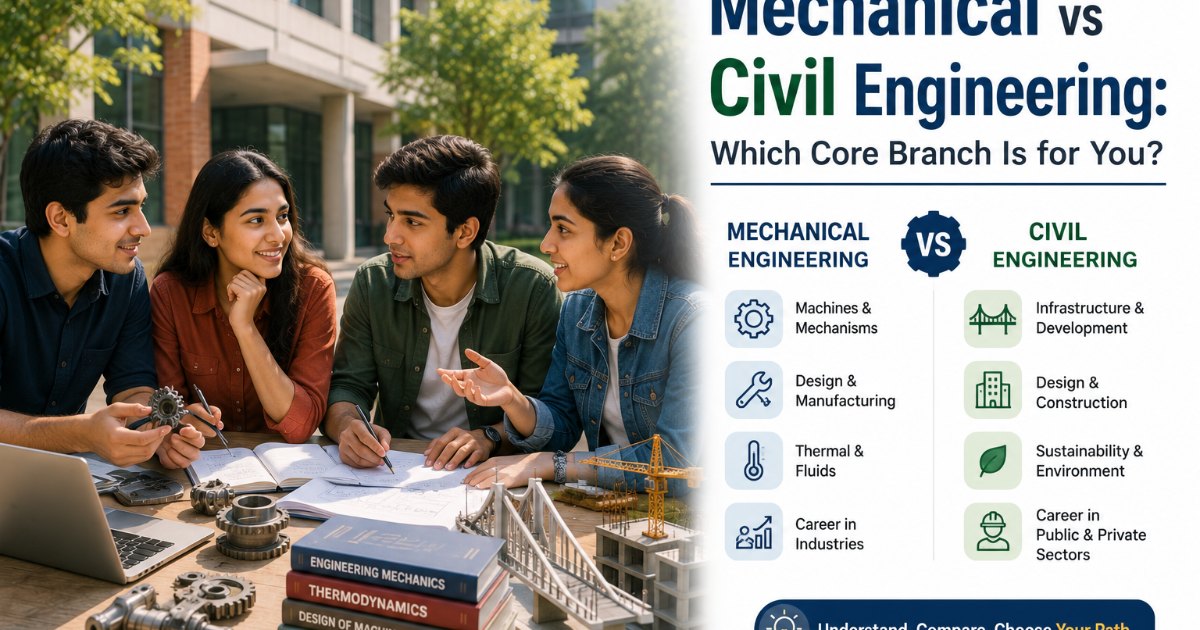 Career Guidance Mechanical vs Civil Engineering: Which Core Branch Is for You? choose mechanical engineering if you are drawn to machines, manufacturing, automotive, EV and energy; choose civil engineering if you are drawn to construction, infrastructure, transport and water systems. Both are evergreen core branches with strong GATE/PSU routes and similar starting pay; mechanical has the broader manufacturing base while civil tracks infrastructure spending — decide by genuine interest, since both also let you pivot to IT or analytics later. June 2026 Read →
  Guides Honours vs General Degree Under NEP: What Should You Choose? under NEP 2020, a general degree is the 3-year bachelor's (with an option to exit earlier with a certificate or diploma), while an honours degree adds a 4th year of specialised coursework and, with research, makes you eligible for direct PhD admission and a 1-year master's. Choose the 4-year honours if you want research, academia or to study abroad; choose the 3-year general degree if you want to start working sooner or head into a professional exam or traditional master's — and confirm your university's rollout, since it still varies. June 2026 Read →
  Career Guidance M.Tech vs MBA After B.Tech: Which Should You Choose? M.Tech vs MBA in India is not a winner-loser contest - it is a fit question driven by your engineering branch, the tier of programme you can convert, and the career you actually want. M.Tech (entry via GATE, plus GATE-free routes for sponsored candidates and IIT graduates with 8.0+ CGPA) fits deep technical, R&D, PSU and academic careers across 25+ specialisations such as AI, cybersecurity, VLSI, structural, thermal, ocean, mining, textile, biomedical, instrumentation, energy and quantum. MBA (entry via CAT, XAT, GMAT, GRE) fits managerial, consulting, product, finance and ESG roles. Tier matters more than label: a sub-Rs 5 lakh seat at IISc, Jadavpur, COEP, MNNIT, VNIT or FMS Delhi often beats a Rs 20 lakh tier-2 seat on ROI. Choosing well comes down to finding the best-fit Master's degree for your goal, not the louder brand. June 2026 Read →
  Career Guidance B.Sc vs BCA: Which Degree Should You Actually Choose? if you want a direct IT and software career, BCA or a B.Sc in CS/IT is the better fit; if you want broader science options or research, a subject B.Sc (physics, chemistry, maths, biology) suits you — "B.Sc" is a family of degrees, so compare BCA with the specific B.Sc you mean, not with "B.Sc" in general, and remember that after two to three years your skills matter more than the label. June 2026 Read →
 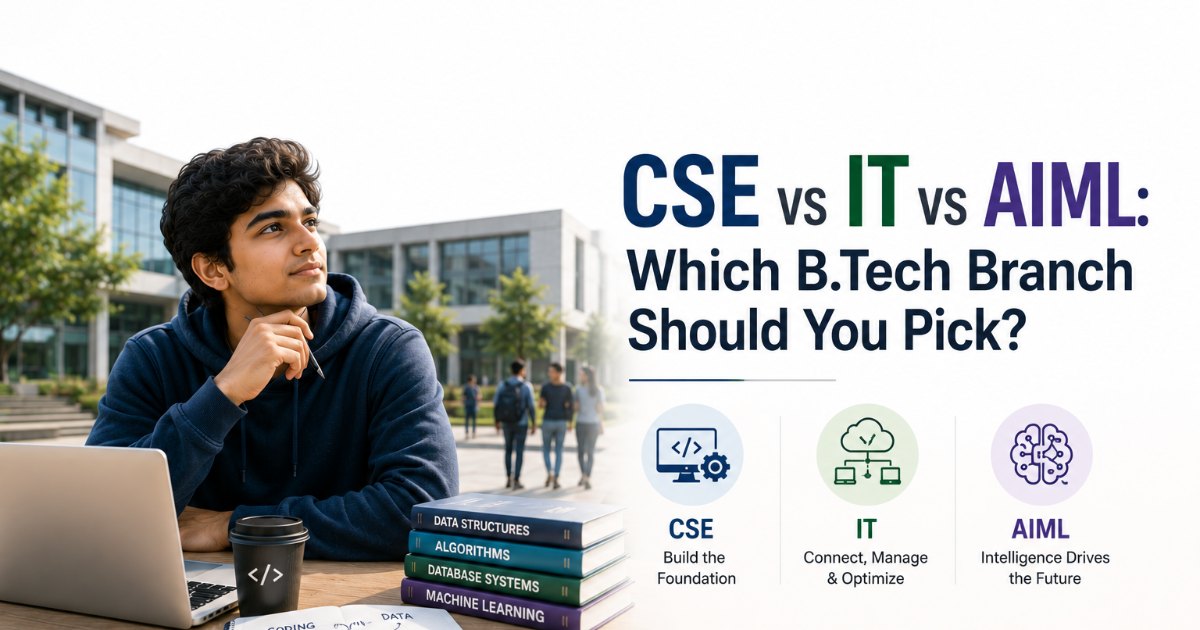 Career Guidance CSE vs IT vs AIML: Which B.Tech Branch Should You Pick? CSE is the broad, versatile core branch; IT overlaps heavily with CSE but leans to applications, networks and systems; AIML is CSE plus a maths-heavy AI and machine-learning specialisation. At top colleges placements are near-identical because hiring is skill-led — choose CSE for breadth and the widest recruiter pool, IT if you prefer applied systems, and AIML only if you genuinely enjoy mathematics and are sure about AI. June 2026 Read →
 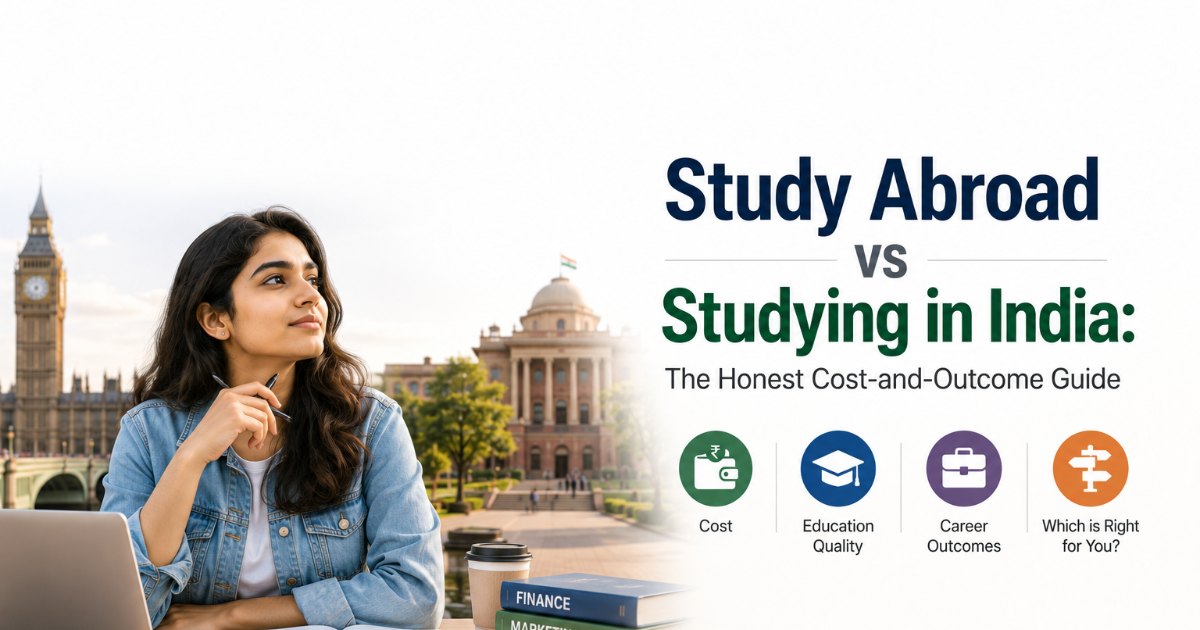 Guides Study Abroad vs Studying in India: The Honest Cost-and-Outcome Guide studying abroad offers exposure and, in some countries, post-study-work or PR pathways, but it commonly costs ₹30 lakh to over ₹1 crore and often a large education loan; studying in India costs far less and its top institutes (IITs, IIMs) offer strong return on investment. Decide by outcome per rupee for your specific course and career, and by your tolerance for loan repayment and visa risk — not by prestige. June 2026 Read →
  Undergraduate BCA vs B.Tech: Which Computer Degree Should You Choose? a BCA is a 3-year computer-applications degree focused on software and programming, while a B.Tech is a 4-year AICTE engineering degree (entered via JEE or state CETs) with a deeper computer-science and engineering core. For most software-developer roles a BCA followed by an MCA reaches a similar place at lower cost; a B.Tech's edge is core and product engineering, GATE and PSU routes, and stronger campus placements. Choose by goal, budget and how much you enjoy maths. June 2026 Read →
  Undergraduate Is a BBA Worth It in India? An Honest Verdict a BBA is worth it if you intend to follow it with an MBA or a strong specialisation and you choose a college with a genuine placement record; on its own, from a weak college, it pays modestly (around ₹3–6 lakh) and is not a shortcut to management roles. Treat the BBA as the first half of a BBA-then-MBA plan rather than a complete qualification. June 2026 Read →
 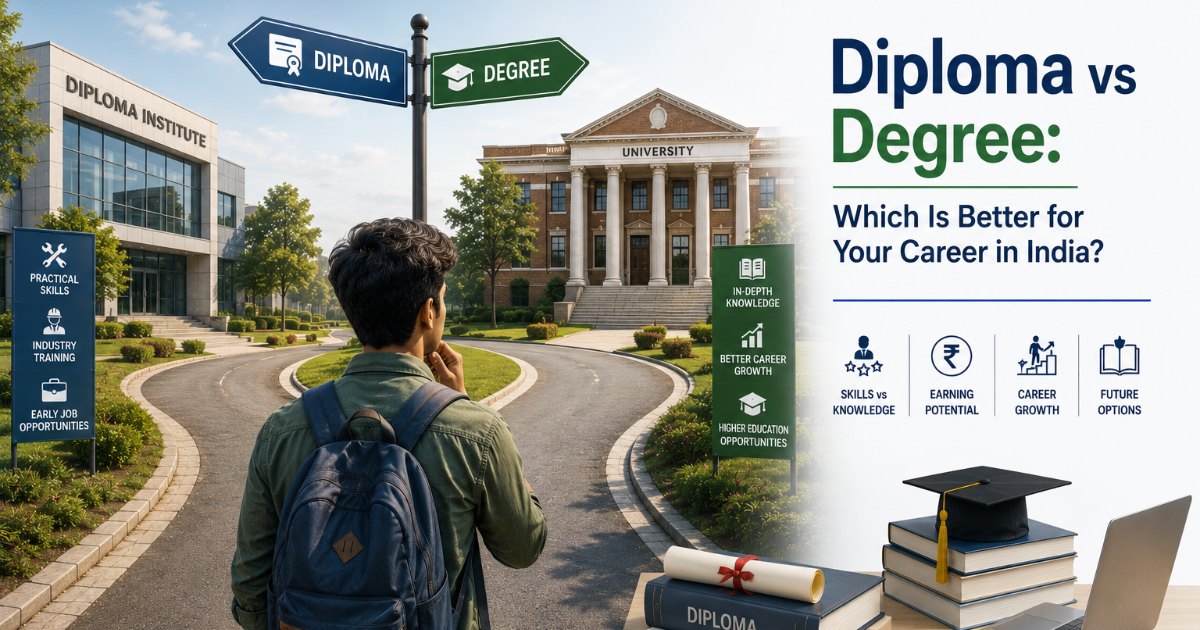 High School Diploma vs Degree: Which Is Better for Your Career in India? a diploma is shorter (about 1–3 years), often entered after 10th, cheaper and more job-ready, while a degree (3–4 years) is deeper and has a higher long-term ceiling. A diploma can lead to a degree later through lateral entry into the second year. Choose a diploma to start earning sooner or a degree for greater long-term progression — neither is universally better. June 2026 Read →
 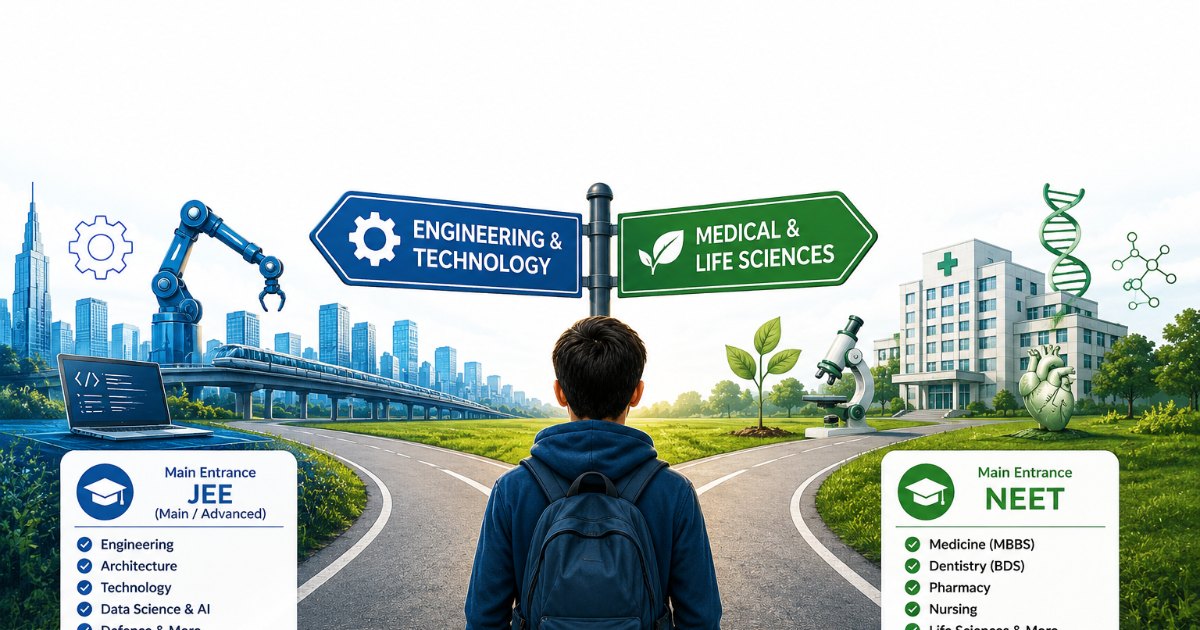 High School PCM vs PCB: How to Choose the Right Science Stream After 10th PCM (Physics, Chemistry, Maths) leads to engineering, architecture and technology via exams like JEE, while PCB (Physics, Chemistry, Biology) leads to medical, dental and life-science careers via NEET. PCM suits maths-and-problem-solving students; PCB suits biology-and-healthcare students. PCMB keeps both open but is a heavier load — choose by the entrance you are genuinely willing to prepare for. June 2026 Read →
 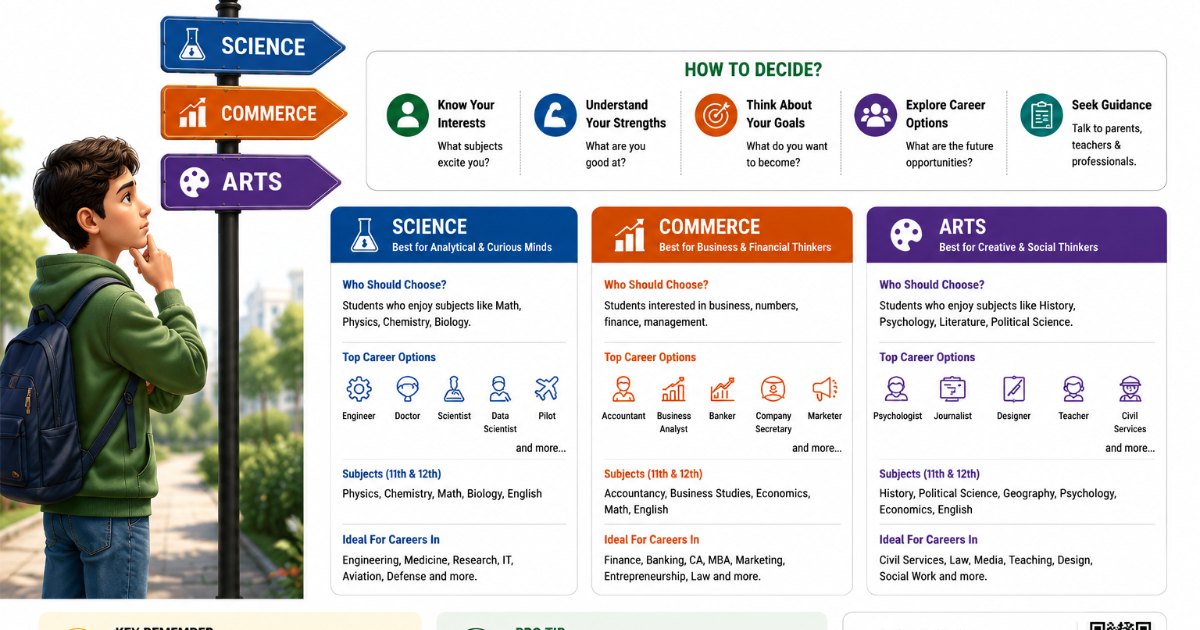 High School How to Choose a Stream After 10th: Science, Commerce or Arts to choose a stream after 10th, start from your genuine interest and aptitude rather than prestige or pressure: Science suits future engineers, doctors and researchers; Commerce suits business, accounting and finance; Arts suits law, civil services, design and psychology. Science keeps the most options open but only if you want it — switching streams later is possible, so choose by fit. June 2026 Read →
  High School Career Options After 12th Arts: The Honest, Complete Map after 12th arts you can pursue BA honours degrees, professional routes (law via CLAT, design via UCEED/NID, journalism, hotel management), the civil services (open to any graduate), or psychology and social sciences — most pay best when paired with a master’s or a professional entrance, so choose by interest and your appetite for further study. June 2026 Read →
 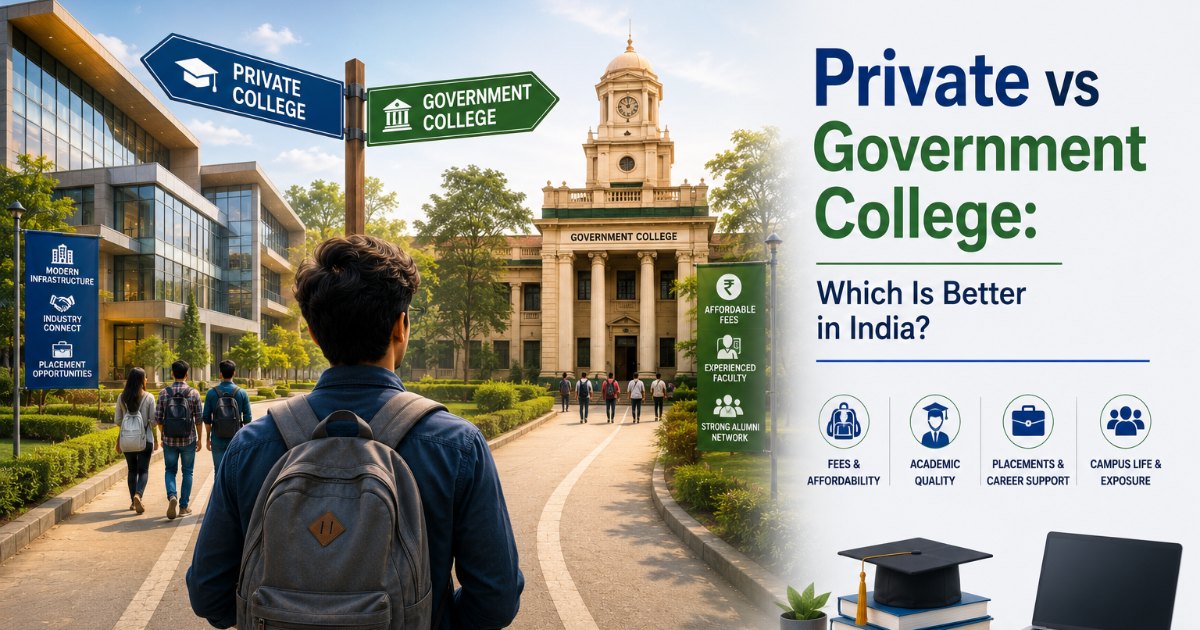 High School Private vs Government College: Which Is Better in India? neither government nor private colleges are universally better — it depends on the specific course and college. Government colleges usually cost far less and carry strong legacy brands, while private colleges range from elite to weak and cost more. Judge by branch-level placements, NIRF data and faculty for the exact course you want, not by the government-versus-private label. June 2026 Read →
  High School BBA vs B.Com: Which Commerce Degree Should You Choose? BBA focuses on management, marketing and HR and is a natural lead-in to an MBA, while B.Com focuses on accounting, taxation and finance and feeds professional routes like CA, CS and CMA. Both pay modestly at entry (around ₹3–6 lakh) and both can lead to an MBA, so choose BBA if you see yourself as a manager and B.Com if you are drawn to accounting and finance. June 2026 Read →
  Undergraduate Design Careers in India: B.Des, NID and the UX Boom design is a strong career in India — especially UX and product design, where top-school graduates earn well — but outcomes are driven by your portfolio and institute more than the degree label, and entry is through aptitude tests like UCEED, NID DAT and NIFT rather than drawing skill alone. June 2026 Read →
  Guides What Is NIRF Ranking? How the Score Works (2026) NIRF ranks Indian institutions on five parameters — teaching and resources, research, graduation outcomes, outreach and perception — but it measures the institution overall, not your branch, fit, fees or location, so treat the rank as one useful signal among several, not the whole decision. June 2026 Read →
  Undergraduate Beyond MBBS: Allied Health & AYUSH Careers in India beyond MBBS, PCB students can pursue physiotherapy (BPT), nursing, pharmacy (B.Pharm) and AYUSH (BAMS, BHMS) — all licensed careers with modest entry pay that grows meaningfully through specialisation, private practice or overseas roles, especially for nurses. June 2026 Read →
  Undergraduate Is a B.Tech in Artificial Intelligence & ML Worth It? a B.Tech in AI & ML is worth it if you genuinely enjoy mathematics, statistics and programming — demand and entry salaries are strong, but it is maths-heavy and a broad CSE core can keep more doors open, so choose AIML only if you are sure AI is your direction. June 2026 Read →
  High School Career Options After 12th Science (PCM & PCB) after 12th science, PCM students can pursue engineering, B.Sc, architecture, design or defence, and PCB students can pursue MBBS/BDS, AYUSH, nursing, pharmacy, allied health or life-science research — with data science open to both; many pure-science paths reward a postgraduate degree, so choose by interest and aptitude. June 2026 Read →
  High School Career Options After 12th Commerce: The Complete Map after 12th commerce you can pursue B.Com or BBA, the professional route (CA, CS, CMA), economics and data, law (BBA-LLB) or management — most pay best when paired with a postgraduate degree or professional qualification, so choose by interest and your appetite for further study. June 2026 Read →
  Professional CA vs CS vs CMA: Which Commerce Path Should You Choose? choose CA for audit, tax and financial reporting (ICAI), CS for corporate law, governance and compliance (ICSI), and CMA for costing and strategic finance (ICMAI) — all are demanding multi-year qualifications with low pass rates, so pick by genuine interest and commitment. June 2026 Read →
  Postgraduate MBA vs PGDM: The Honest Difference for Indian Students an MBA is a university degree and a PGDM is an autonomous-institute diploma (usually AICTE-approved); neither is automatically better — choose by the institute’s placements, recruiters and accreditation, and check AIU equivalence if you may pursue a PhD or government job. June 2026 Read →
 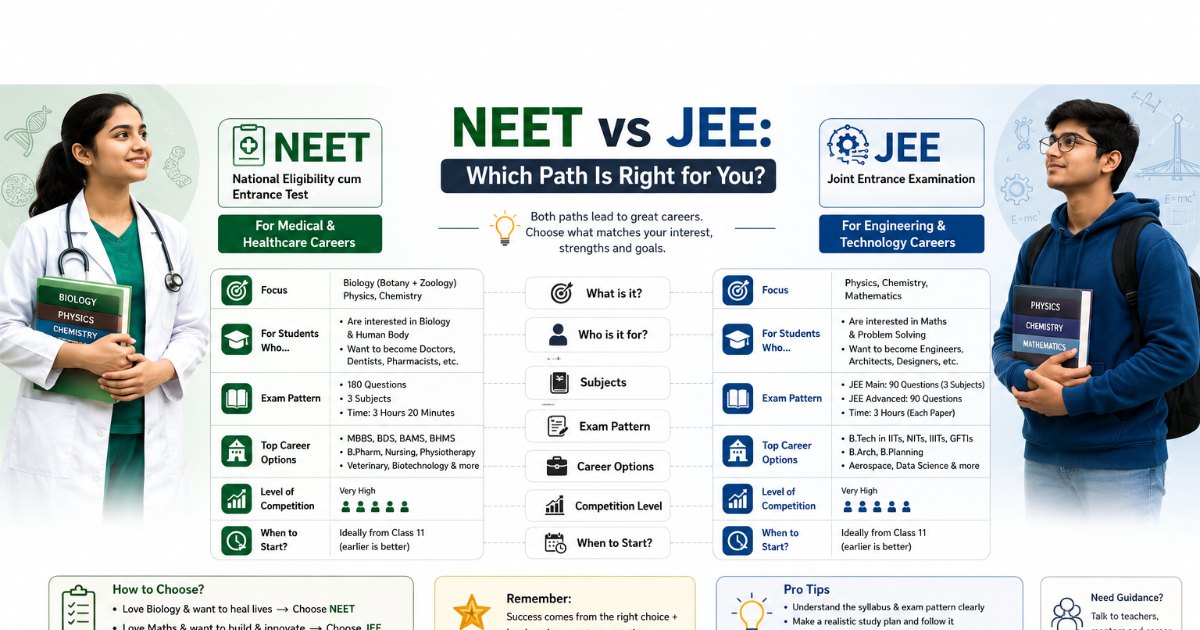 High School NEET vs JEE: Which Path Is Right for You? choose NEET if you are drawn to medicine and patient care and can commit to a long path; choose JEE if you enjoy problem-solving and want broader, faster-evolving career options — decide by genuine interest and aptitude, not prestige. June 2026 Read →
  Guides How to Choose the Right College After 12th in India choose a college by matching the course strength to your interest and aptitude, then comparing NIRF/AICTE data, branch-wise placements, fees and location — fit matters more than brand. June 2026 Read →
 No articles match your search.