Mechanical vs Civil Engineering: Which Core Branch Is for You?
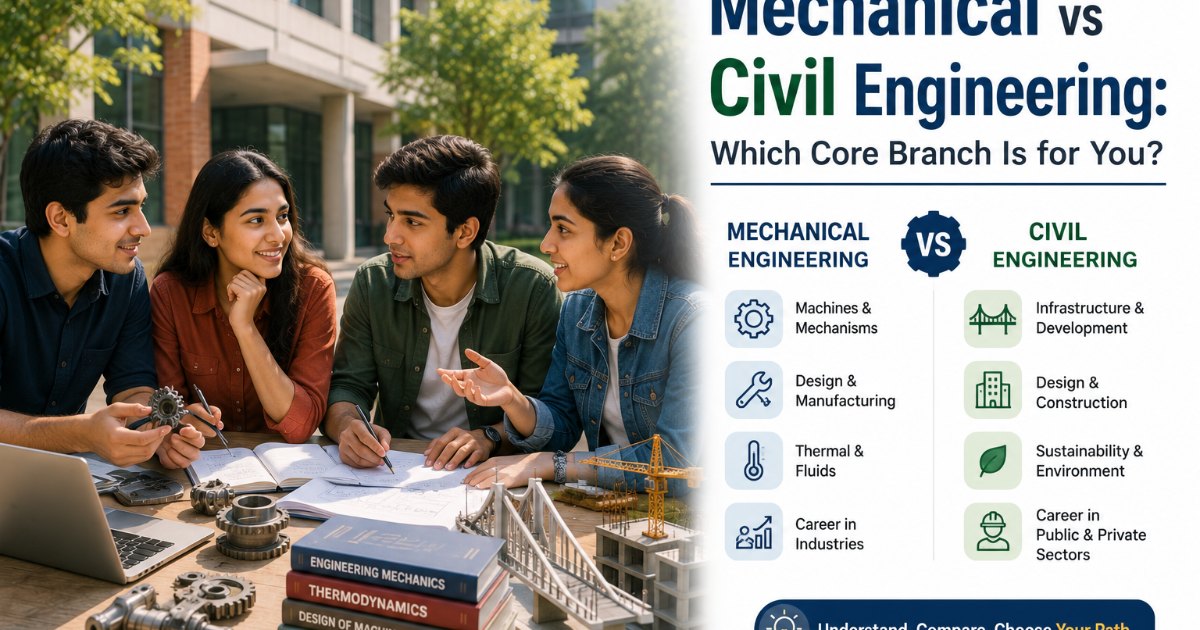
Choosing between mechanical vs civil engineering is really a choice between two different worlds of work — machines and manufacturing on one side, structures and infrastructure on the other. Both are evergreen "core" branches that have powered the economy for over a century, and neither is going away. Mechanical engineering is the broad branch behind manufacturing, automotive, energy and the growing EV and robotics fields. Civil engineering builds the physical world — roads, bridges, buildings, metros, dams and water systems. The honest way to decide is not "which is better" or "which pays more", because the answers are close. It is "which kind of work genuinely interests me", because both are demanding, both have strong public-sector routes, and in both, your interest is what will carry you through four years and a career. In this guide we compare what each branch builds, their real job sectors, the all-important GATE and PSU route, the honest parts about cyclicality and the IT pivot, where each field is heading, and a simple decide-by-interest framework — so you can make this call on substance rather than on which branch sounds more impressive.
What each branch builds
The cleanest way to tell them apart is by what you'll actually work on:
- Mechanical engineering — anything that moves or makes things: engines, machines, manufacturing lines, automobiles, HVAC, robotics, EV powertrains, thermal and energy systems, product design. It is the most versatile core branch.
- Civil engineering — the built environment: buildings, highways, bridges, railways and metros, dams, water supply and sanitation, surveying and structural design. It tracks a country's infrastructure spending.
If you are the kind of person who opens up gadgets to see how they work, mechanical will feel natural. If you are drawn to large structures and how cities are built, civil will. That instinct is a better guide than any salary table.
Talk to a CourseLane advisor — free, and no obligation.
Mechanical vs civil at a glance
An honest side-by-side. Salary figures are indicative ranges that vary widely by employer, location and whether you clear a competitive route like GATE.
| Factor | Mechanical Engineering | Civil Engineering |
|---|---|---|
| Core domain | Machines, manufacturing, energy, EV | Construction, infrastructure, water |
| Main job sectors | Auto, manufacturing, energy, aerospace, EV | Construction, real estate, transport, government |
| Top PSUs (via GATE) | NTPC, ONGC, GAIL, BHEL, HPCL, BPCL, NPCIL | AAI, NHAI, NPCIL, NLC, PowerGrid |
| GATE-PSU starting pay (indicative) | ₹9–15L | ₹9–15L |
| Market driver | Manufacturing & auto cycles | Infrastructure & construction spending |
| Software to learn | CAD/CAM, SolidWorks, ANSYS | AutoCAD, STAAD, BIM/Revit |
Both branches reach their best government salaries through the same door — GATE — and both face competitive cut-offs. The difference is the sector you'll spend your career in, not the headline number.
Career scope and job sectors
Mechanical graduates spread across the widest range of industries — automotive and EV, manufacturing and production, energy and power, aerospace, HVAC, and increasingly robotics and automation. That breadth is mechanical's biggest strength: it is rarely tied to a single sector. Civil graduates concentrate in construction, real estate, infrastructure and transport, plus a strong government and PSU presence (NHAI, AAI, state PWDs, railways). Civil's fortunes rise and fall with infrastructure spending, which in India has been strong — but it is more cyclical than mechanical's broader base. Both branches let you move into site, design, project management, quality, or government roles.
The GATE and PSU route
For both branches, the most sought-after stable jobs come through GATE (the Graduate Aptitude Test in Engineering), which is the gateway to PSU recruitment and to an M.Tech. Mechanical engineers are recruited by PSUs such as IOCL, ONGC, NTPC, GAIL, BHEL, HPCL, BPCL and NPCIL (note that SAIL has historically used its own Management Trainee exam in addition to or instead of GATE in various cycles — IOCL's Engineers/Officers recruitment continues to use GATE scores with CBT/GD/PI weightage, so always check the current year's notification); civil engineers by AAI, NHAI, NPCIL, NLC and PowerGrid, among others. Indicative starting CTC through these routes sits around ₹12–17 lakh per annum (for example, NTPC EET 2026 E1 grade Rs 40,000–1,40,000 basic with CTC ~Rs 12–14 LPA; IOCL Officers ~Rs 17.32 LPA CTC; NPCIL ET Rs 74,000/month stipend during training, then 7th-CPC Level-10 Rs 56,100–1,77,500); figures vary by employer, location and posting. Be realistic: core-branch GATE cut-offs for PSUs are competitive, so a PSU job is earned, not guaranteed — but it is one of the best outcomes in either branch.
And the honest fuller picture: PSU recruitment does not happen only via GATE. Each PSU has its own eligibility and entrance norms — many also recruit through their own examinations or through other competitive exams. For example, Indian Railways runs the RRB Junior Engineer (JE) and Senior Section Engineer (SSE) recruitment for civil and mechanical cadres via its own boards; ISRO recruits Scientist/Engineers primarily through the ICRB's own written test + interview (some notifications use GATE as a shortlisting proxy, but the standing route is the ICRB exam); BARC recruits via the OCES/DGFS exam (GATE is one of several qualifying routes, not the only one); UPSC Engineering Services Examination (ESE) recruits Group A engineers across central engineering services; SSC JE recruits Junior Engineers for CPWD, MES and similar departments. So while GATE remains the headline route for many core-PSU technical posts, treating PSU recruitment as a GATE monoculture is a half-truth — always check the specific PSU's own notification for the actual eligibility and selection process.
The honest part: cyclicality and the IT pivot
Here is what glossy comparisons skip. Core-branch hiring tends to be more cyclical than software hiring (anecdotal observation — core hiring tracks capex cycles in oil and gas, steel and infrastructure, while software tracks digital-services demand) — it moves with manufacturing demand and infrastructure budgets — and early-career core salaries are often lower than IT salaries. As a result, a sizeable share of mechanical and civil graduates pivot into IT, analytics, management or government roles, especially from non-top colleges. This is not a failure of the branch; it reflects where the broader job market has been. Go into core engineering because the work genuinely interests you — if your real goal is a software salary, be honest about that now rather than after four years.
Fees, colleges and what to verify
Fees vary widely between government and private colleges; treat advertised figures as indicative and verify per institute. For core branches especially, the college's industry connections, labs and placement record in that specific branch matter more than the overall brand. Look for AICTE-approved, NIRF-ranked institutions with active core recruiters, and check branch-wise placements rather than the topline number. You can use the CourseLane colleges directory as a starting reference to compare engineering colleges side by side. Listed fee and placement figures are indicative, so before any admission decision please mandatorily contact the respective college's admission cell or placement cell to confirm branch-wise outcomes.
Which is tougher?
Neither is objectively harder — they are hard in different ways. Mechanical leans on thermodynamics, mechanics, manufacturing and a lot of mathematics and physics; civil leans on structural analysis, fluid mechanics, surveying and materials, with heavy responsibility because lives depend on safe structures. Students who love physics and machines find mechanical's load manageable; students who think spatially and like the built environment cope well with civil. "Tough" is mostly a function of interest — the subject you enjoy will feel lighter than the one you don't.
Job-market reality: demand and stability
It's worth being clear-eyed about the job market, because it shapes both branches. Both mechanical and civil are large, long-established branches that produce a lot of graduates, so competition for the best roles is real, and entry-level pay in the private sector is often lower than in software — one honest reason a meaningful share of core-branch graduates move into IT, analytics or management. This is not a reason to avoid either branch; it is a reason to go in with a plan rather than an assumption that the degree alone guarantees a great job.
Where the two differ is in what drives demand. Mechanical demand is spread across manufacturing, automotive, energy and a growing EV and automation sector, so it is somewhat insulated by its breadth. Civil demand tracks infrastructure and construction spending, which in India has been strong but is more cyclical — busy when projects are funded, slower when they aren't. The most stable, well-paid outcomes in both branches tend to come through the GATE-to-PSU route or a specialisation, which is why students who are serious about either branch treat GATE preparation and a chosen specialisation as part of the plan from early on, rather than leaving their career to chance.
Where each branch is heading
Neither branch is standing still, and the modern versions look quite different from the textbooks. Mechanical engineering is being reshaped by electric vehicles, robotics, automation and clean energy — the same fundamentals (mechanics, thermodynamics, design) now feed EV powertrains, battery and thermal systems, industrial robots and smart manufacturing. A mechanical graduate who picks up CAD/CAM, simulation tools and some programming is well placed for this shift. Civil engineering is modernising into smart and sustainable infrastructure: green buildings, Building Information Modelling (BIM), advanced materials, water and environmental management, and the large metro, highway and urban-development programmes that come with infrastructure investment. A civil graduate fluent in BIM, structural software and project management has a real edge.
The honest takeaway: both branches reward students who add modern tools to the core fundamentals. The degree gives you the foundation; the software skills, internships and a willingness to specialise in an emerging area (EV and robotics on the mechanical side, smart infrastructure and sustainability on the civil side) are what make you genuinely future-ready. Don't choose on which sounds more 'futuristic' — both are evolving — choose on which set of problems you'd enjoy solving, then deliberately build the current skills that field now expects.
What the work actually feels like
Brochures describe sectors; they rarely tell you what your days will feel like, and that matters because you'll live them for a career. A mechanical engineer's work often centres on design and analysis — modelling a component in CAD, running simulations, improving a manufacturing process, troubleshooting a machine on a shop floor, or developing a thermal or EV system. It tends to mix desk-based design with time in workshops and plants, and it rewards people who like to understand how a mechanism works and make it work better.
A civil engineer's work swings more between the office and the site. You might spend mornings on structural calculations, drawings or BIM models and afternoons on a construction site checking that what was designed is being built safely and correctly. It carries visible responsibility — the bridge, building or road you work on is used by the public — and it suits people who like seeing something large and permanent take shape. Neither is glamorous every day; both involve real problem-solving, coordination and pressure. Picturing which of these two daily rhythms you'd find satisfying is one of the most useful things you can do before choosing, far more than comparing salary averages you can't yet influence.
Specialisations within each branch
Both branches open into specialisations, usually deepened through an M.Tech or on-the-job experience, and knowing them helps you see the long-term map. Mechanical specialisations include thermal engineering, design engineering, manufacturing and production, automotive and EV systems, robotics and automation, mechatronics, and aerospace. Civil specialisations include structural engineering, geotechnical engineering, transportation engineering, water resources and environmental engineering, and construction or project management.
This matters for two reasons. First, the broad branch you pick at admission is only the beginning — your real expertise comes from the specialisation you grow into. Second, some of the most future-facing roles sit in specific specialisations: EV and robotics on the mechanical side, smart infrastructure and environmental engineering on the civil side. So when you compare the two branches, also glance at which of these specialisations appeals to you, because that is where your career will eventually focus. Choosing the broad branch whose specialisations excite you is a smarter test than choosing on the generic branch name alone.
Skills to build alongside the degree
In both branches, the graduates who do best add practical, modern skills to the core curriculum:
- Software fluency — mechanical: CAD/CAM, SolidWorks, ANSYS; civil: AutoCAD, STAAD.Pro, BIM/Revit. Employers expect these.
- Internships and site/industry exposure — real experience separates candidates far more than marks.
- GATE preparation if you want a PSU job or an M.Tech — start early, because core-branch cut-offs are competitive.
- A specialisation focus — pick an emerging area (EV, robotics, structural, environmental) and build depth in it.
- Communication and project skills — both branches involve coordinating teams, contractors and clients.
The pattern echoes the rest of this guide: the degree is the foundation, but the modern tools, internships and a chosen specialisation are what make you genuinely employable. Neither mechanical nor civil rewards a student who does the bare minimum — and both reward one who builds these skills deliberately.
Future education paths: M.Tech, MS, PhD and beyond
Both branches lead onto a strong postgraduate ladder, and knowing it helps you see past the first job. The usual routes are an M.Tech in a chosen specialisation (via GATE, often with a stipend at IITs and NITs), an MS abroad, and — for the research-minded — a PhD leading to R&D, academia or specialist roles in industry. For mechanical that might mean an M.Tech in thermal, design, automotive or robotics; for civil, in structural, geotechnical, transportation or environmental engineering. The same GATE score that earns a PSU job can also secure an M.Tech seat, so the exam does double duty.
Two other paths are worth naming. Many core-branch engineers later add an MBA to move into management, project leadership or consulting — a common and respected pivot. And a growing number move toward data and analytics roles via short specialisations, since both branches generate plenty of data to model. So a mechanical or civil degree is not a narrow track; it is the base of a ladder that can reach a doctorate, a management career or a data-driven role. If research appeals, aim for a strong undergraduate record and a GATE rank, because those open the M.Tech, PhD and fellowship doors.
Futuristic careers and where to study them
The forward-looking roles in each branch are genuinely exciting. On the mechanical side: electric-vehicle and battery systems, robotics and automation, mechatronics, additive manufacturing (3D printing), renewable-energy systems and aerospace. On the civil side: smart and sustainable infrastructure, Building Information Modelling (BIM), green-building design, structural health monitoring, and water and environmental engineering. These are where demand is growing fastest, and they reward students who build the matching modern skills during the degree rather than waiting until after it.
On where to study: the IITs and NITs are the flagship engineering institutes with the strongest core-branch recruiters and GATE/PSU outcomes, while many state and private universities run solid programmes — and for core branches especially, the quality of the labs, the industry links and the branch-wise placement record matter more than the overall brand. Choose the strongest college you can for your branch, then specialise toward one of these emerging areas. Use the CourseLane colleges directory as a starting reference to compare institutions, and target the one whose strengths match the future-facing field you want to enter. Listed figures are indicative, so before deciding please mandatorily contact the respective college's admission cell or placement cell.
How to decide
Use interest, not averages, to settle it:
- I'm fascinated by machines, engines, cars and how things are made → mechanical engineering.
- I'm drawn to buildings, bridges, roads and how cities are built → civil engineering.
- I want the broadest range of industries to work in → mechanical, with its wider sector base.
- I want strong government/PSU and infrastructure exposure → civil, which has a deep public-sector presence.
- I'm aiming for a PSU job → either branch via GATE; prepare for competitive cut-offs.
- I mainly want a software salary → be honest and consider a computing branch instead, rather than pivoting later.
Both are respectable, durable careers with strong public-sector routes and steady long-term demand. Choose the one whose daily work you can genuinely see yourself enjoying for years, build the modern software and field skills that field now expects, and prepare seriously if a PSU job is your goal — that is the choice, and the effort, you won't regret.
Sources & official references
The figures and rules above are drawn from official Indian education authorities. Always confirm the latest details on these sources before you decide:
How CourseLane can help you decide
Choosing well comes down to finding your best-fit degree course. Our career counselling page sets out the options for matching your interests and aptitude to the right courses, and you can compare colleges and indicative fees on officially-sourced data across the CourseLane colleges directory.
Written and fact-checked by the CourseLane Editorial team and reviewed by the CourseLane Research Team. CourseLane sources figures from official authorities such as NIRF, AICTE and UGC, labels indicative ranges clearly, and never fabricates data.
Talk to a CourseLane advisor — free, and no obligation.
Frequently asked questions
Which is better, mechanical or civil engineering?
Neither is universally better — they suit different people. Mechanical engineering is broader, spanning manufacturing, automotive, EV and energy; civil engineering builds infrastructure and has a strong government and PSU presence. Salaries and GATE/PSU routes are similar. Choose mechanical if machines fascinate you and civil if structures and the built environment do — interest matters more than any ranking. Both are demanding four-year commitments, so the branch you genuinely find interesting is the one you'll do well in; picking the 'wrong' branch for a marginally higher salary headline is a common and avoidable mistake.
Which has more scope, mechanical or civil?
Mechanical arguably has the wider scope because it spans more industries — auto, manufacturing, energy, aerospace, EV and robotics — and is less tied to a single sector. Civil's scope is large too but tracks infrastructure and construction spending, making it more cyclical. Both have strong public-sector routes, so 'more scope' depends on whether you value breadth (mechanical) or infrastructure depth (civil). It's also worth noting that scope keeps shifting: mechanical is expanding into EV and automation, while civil is growing through large metro, highway and smart-city programmes — so both have healthy long-term demand for graduates who build the right modern skills.
Which has a higher salary, mechanical or civil engineering?
Starting salaries are broadly similar and depend far more on the route than the branch. Through GATE-based PSU recruitment, both can expect an indicative starting CTC of ₹12–17 lakh per annum (for example NTPC EET 2026 E1 basic Rs 40,000–1,40,000 with CTC ~Rs 12–14 LPA; IOCL Officers ~Rs 17.32 LPA CTC) with strong benefits and job security — verify per PSU notification. In the private sector, mechanical's manufacturing and energy roles and civil's construction and project roles vary widely, and early core-branch pay is often lower than software pay — one honest reason many graduates later pivot to IT or analytics. Within a few years, your skills, specialisation and whether you cleared a competitive route like GATE matter far more than whether your degree says mechanical or civil.
What is the difference between mechanical and civil engineering?
The core difference is what you build. Mechanical engineering deals with machines and moving systems — engines, manufacturing, thermodynamics, robotics, EVs and energy. Civil engineering deals with the fixed built environment — buildings, bridges, roads, dams and water supply that communities rely on. In short, mechanical designs machines while civil designs structures; both are four-year degrees that share a common early foundation in physics and maths before diverging.
Is mechanical engineering tougher than civil?
Neither is objectively tougher — they are demanding in different areas. Mechanical is heavy on thermodynamics, mechanics and manufacturing with a lot of physics and maths; civil is heavy on structural analysis, fluid mechanics and materials, with serious safety responsibility because real structures and lives depend on getting the calculations right. The branch you find 'tougher' is usually the one you're less interested in, so let genuine interest guide you — the subject you enjoy will always feel lighter than the one you merely tolerate.