CSE vs IT vs AIML: Which B.Tech Branch Should You Pick?
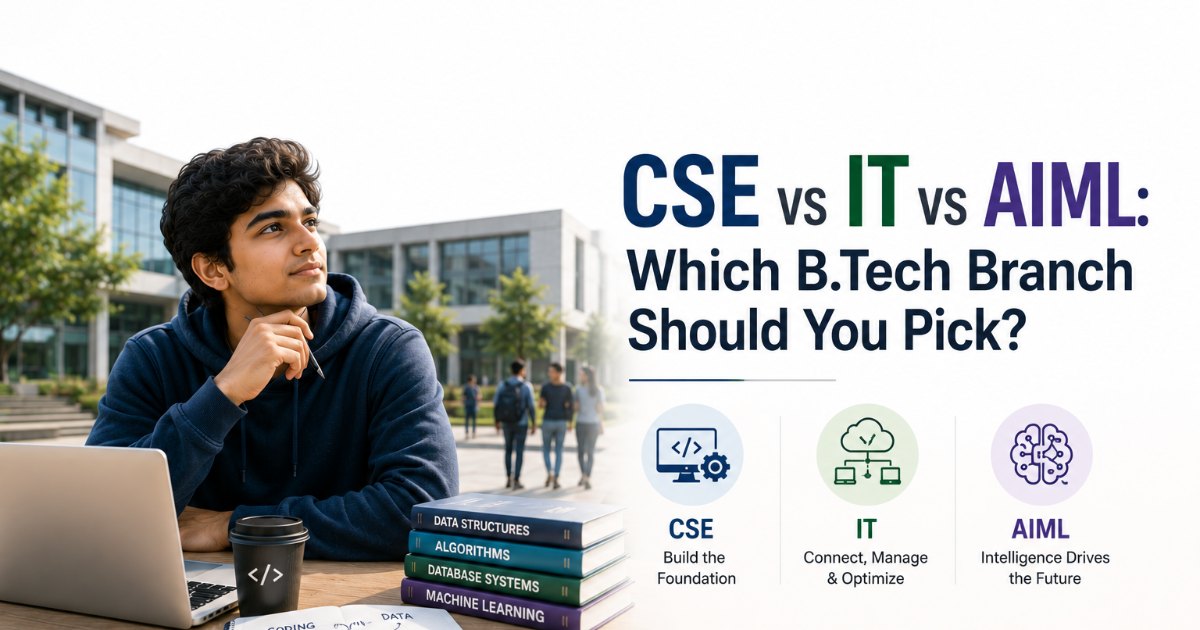
If you are stuck on CSE vs IT vs AIML while filling B.Tech choices, here is the honest truth the brochures won't tell you: these three branches overlap far more than they differ, and the branch name on your degree matters much less than the college you attend and the skills you build. Computer Science Engineering (CSE) is the broad core branch. IT (Information Technology) shares most of the same syllabus but leans toward applications, systems and networks. AIML — Artificial Intelligence and Machine Learning — is not a different field at all; it is CSE with a maths-heavy AI specialisation layered on top. At a top college, a student in any of the three (such as CSE, IT and AIML) often sits in the same placement queue and walk away with near-identical offers, because companies hire on demonstrated skill, not on the three letters after "B.Tech". So the real decision is about fit and breadth, not prestige. This guide breaks down what each branch actually teaches, how much they overlap, what truly drives placements, the maths question that decides AIML, and a clear goal-based matrix — so you choose on evidence rather than on which branch sounds most futuristic in a brochure.
What each branch actually is
Strip away the marketing and the three branches line up like this:
- CSE — the foundational computing degree: programming, data structures, algorithms, operating systems, databases, computer networks, software engineering, with electives spanning web, cloud, cybersecurity, data and AI. The widest possible base.
- IT — heavily overlapping with CSE, but tilted toward applying technology: information systems, networking, system administration, web and enterprise applications. Slightly less theory, slightly more applied.
- AIML — the CSE core plus a focused stack of machine learning, deep learning, natural language processing and computer vision, with extra mathematics (linear algebra, probability, statistics, optimisation).
Notice the pattern: CSE and IT are siblings, and AIML is CSE wearing a specialist coat. None of them locks you out of the others' jobs.
Talk to a CourseLane advisor — free, and no obligation.
CSE vs IT vs AIML at a glance
The at-a-glance comparison. Treat any salary as indicative — at strong colleges the branch barely moves your first package.
| Factor | CSE | IT | AIML |
|---|---|---|---|
| Core idea | Broad computing foundation | Applied tech, systems & networks | CSE core + AI/ML specialisation |
| Maths intensity | Moderate (discrete maths, logic) | Moderate | High (linear algebra, probability, stats) |
| Recruiter pool | Widest | Wide | Wide + niche AI roles |
| Best for | Keeping all options open | Applied/enterprise systems | Students sure about AI & comfortable with maths |
| Cleanest master's | M.Tech CS / AI / any | M.Tech IT / CS | M.Tech AI/ML |
The honest headline: at IITs, NITs and BITS the packages are nearly the same across all three because hiring is skill-led. At tier-2 and tier-3 colleges, AIML can have a slight edge for niche AI roles, while CSE enjoys the largest pool of recruiting companies.
How much do they really overlap?
A great deal. In most universities, CSE and IT share roughly two-thirds to three-quarters of their core subjects — both teach programming, data structures, databases, networks and software engineering. AIML students study the entire CSE core in their early semesters before the AI specialisation kicks in. This is why a CSE graduate can comfortably move into AI/ML, web, cloud or cybersecurity, and an IT graduate can move into software development — the foundations are shared. The branch decides your defaults and electives, not your ceiling.
Placements: branch name vs college tier vs skills
Here is the order that actually decides your placement, from most to least important: your skills and projects → the college's recruiter pool and brand → and only then the branch name. A CSE student at a tier-3 college with no projects will struggle; an AIML student at the same college with three strong projects and a public portfolio will do well. The branch is a small lever compared with what you build and where you study. If you want the widest set of companies visiting for you, CSE is the safe default; if you are certain about AI and enjoy the maths, AIML concentrates your learning where you want it.
The maths question (and who AIML really suits)
AIML is meaningfully more mathematical than CSE or IT. Machine learning rests on linear algebra, probability, statistics and optimisation, and the comfortable AIML student is someone who genuinely enjoys that — not someone chasing a buzzword. If mathematics has always felt like a chore, a broad CSE degree (where you can still take AI electives) is the wiser, lower-risk choice. If you light up at the maths and are sure AI is your direction, AIML rewards that focus. Be honest with yourself here — this single question resolves most CSE-vs-AIML dilemmas.
The strongest path: CSE now, specialise later
One route consistently keeps the most doors open: do CSE for the undergraduate degree, then specialise in a master's. Most M.Tech AI/ML programmes at IITs and NITs accept students with a CSE background, so a CSE undergrad + AIML postgrad combination gives you breadth first and depth later — without betting everything on AI at eighteen. If you are drawn to data specifically, data-focused programmes and electronics-leaning options like ECE are also worth a look. The point: you can reach AI from CSE, but a narrow AIML degree makes pivoting away from AI harder.
Fees, recognition and choosing the college
Across all three branches, treat advertised fees as indicative and verify them per institute. What matters more than the branch is whether the college is well-regarded and well-connected: under AICTE approval and NIRF-ranked institutions, the recruiter pool and placement cell often do more for your career than the exact branch you pick. Use the CourseLane colleges directory as a starting reference to compare colleges side by side, rather than choosing on the branch name alone. Listed fee and placement figures are indicative, so before any admission decision please mandatorily contact the respective college's admission cell or placement cell to confirm branch-wise outcomes.
IT vs CSE: sorting out the closest call
Students agonise most over IT vs CSE, because they are so similar — so here is the honest distinction. CSE is built around the science of computing: the theory, the algorithms and the foundations that let you go anywhere, from product engineering to research to AI. IT takes that same toolkit and points it at using technology effectively — information systems, networking, databases, system administration and enterprise applications. Think of CSE as "how computers and software work at their core" and IT as "how organisations deploy and run technology well".
In practice the gap is small and shrinking. Both branches sit for the same campus placements, both can become software developers, and both can move into data, cloud or cybersecurity with the right electives. Where it matters: if you want the absolute widest set of options and the strongest theoretical base — including a clean path into research or AIML later — CSE has a slight edge. If you already know you enjoy the applied, systems-and-deployment side more than deep theory, IT is a perfectly strong choice and not a "lesser CSE". At a good college, an IT graduate with solid projects competes directly with CSE graduates. The branch sets your starting electives; your skills set your ceiling.
A practical way to choose between these two specifically: look at the actual curriculum of the colleges you're considering, not just the branch name. Two colleges can label a branch "CSE" and "IT" yet teach almost the same subjects, or teach quite different ones — the syllabus, the labs, the electives on offer and the recruiters who visit tell you far more than the three letters. If a college's IT programme has strong software and data electives and good placements, it is a better choice than a CSE programme at a weaker college. Read the curriculum, check the recruiter list, and let those decide between CSE and IT rather than a generic belief that one is inherently superior.
Emerging roles each branch feeds into
It helps to look past the branch names to the actual jobs they open, because the modern roles draw from all three. From a CSE base you can move into software engineering, full-stack development, cloud and DevOps, cybersecurity, data engineering and, with the right electives, AI/ML — the widest fan-out of any branch. IT feeds many of the same software roles but has a natural edge toward systems, networking, IT infrastructure, enterprise applications and increasingly cloud administration and DevOps. AIML concentrates on machine-learning engineering, data science, computer vision, NLP and AI research roles, while still keeping the general software door open because of its CSE core.
Notice that almost none of these roles is locked to a single branch. A motivated CSE student can become an ML engineer; an AIML student can build web applications; an IT student can move into cloud or security. What actually decides which of these roles you land is the depth of your projects and internships in that area — the branch sets your most natural starting point, not your destination. That is why, when in doubt, the branch with the broadest base (CSE) is the safest, because it leaves the most of these doors open while you discover which one you want to walk through.
Can you switch or specialise later?
Yes — and this matters more than students realise when they agonise at admission time. Within a degree, your electives, minors and projects let you lean toward AI, data, security or systems regardless of your branch label, so a CSE student set on AI can take ML electives and build AI projects without an AIML degree. Between degrees, the master's is the clean re-specialisation point: a CSE or IT graduate can do an M.Tech in AI/ML, data science or cybersecurity, which is exactly why a broad undergraduate degree plus a focused postgraduate degree is such a strong combination.
The harder direction is narrowing yourself too early. A very specialised AIML degree is excellent if AI is genuinely your path, but it makes pivoting away from AI a little harder than starting broad and specialising later. So if you are confident about AI and enjoy the maths, specialise now; if you are unsure, keep your options wide with CSE and use electives, projects and eventually a master's to specialise once you know your direction. Either way, the branch you pick at eighteen is not a life sentence — your skills and your later choices reshape it.
Common mistakes when picking a branch
The same avoidable errors recur every admission season:
- Choosing AIML for the hype. If you don't enjoy mathematics, a fashionable AI label won't carry you through a maths-heavy course — and recruiters can tell the difference between a real ML skill and a branch name.
- Picking the branch over the college. A good college's recruiter pool and brand usually outweigh the branch; a great branch at a college nobody recruits from helps little.
- Believing IT is a "lesser CSE". It isn't — it overlaps heavily and is a strong choice for the applied, systems-minded student.
- Neglecting projects and internships. Whatever the branch, students who don't build anything struggle; the branch can't compensate for an empty portfolio.
- Forgetting you can specialise later. Many students over-optimise the branch decision when a master's or even electives can redirect them painlessly.
Sidestep these and the choice becomes simple: pick CSE for breadth, IT for applied systems, or AIML for a maths-loving AI focus — then let your skills, not the label, do the talking.
Future education paths: M.Tech, MS abroad and PhD
All three branches open the same strong postgraduate ladder, which is another reason the undergraduate label matters less than students fear. The common routes are an M.Tech in CS, AI/ML, data science or cybersecurity (via GATE, often with a stipend at IITs and NITs), an MS abroad in computer science or a specialisation, and — for those drawn to research — a PhD leading to roles in research labs, academia or advanced R&D. Graduates of any of these three branches (such as CSE, IT and AIML) are all eligible for these, and importantly, most M.Tech AI/ML programmes accept a CSE background, so you do not need an AIML undergraduate degree to specialise in AI later.
There is also a growing route straight into industry research and applied-AI teams for students who build strong projects and publications during the degree. An MBA is open too, usually after some work experience, for those who later move toward product or management. The practical takeaway: pick the branch that fits you now, do well in it, and keep the master's and research doors open — because in computing, the postgraduate step and your demonstrated skills reshape your trajectory far more than the branch printed on your first degree.
The futuristic frontier, and where to study it
Looking ahead, the roles drawing the most attention sit at the frontier: generative-AI and large-language-model engineering, MLOps, AI safety and alignment, data engineering at scale, cloud-native and edge computing, cybersecurity for AI systems, and, further out, quantum computing. Almost all of these grow from a solid CSE or AIML foundation plus deliberate, current skill-building — they reward curiosity and projects more than any specific branch label, and they evolve fast enough that what you teach yourself will matter as much as the syllabus.
On where to study: the IITs, NITs, IIITs and BITS are the flagship technical institutes, with strong recruiter pools across all three branches; many state and private universities also run excellent computing programmes, and the right question is always the strength of the department and the companies that visit. Rather than chase a branch at a weak college, choose the strongest college you can and shape your specialisation through electives, projects and a later master's. Use the CourseLane colleges directory as a starting reference to compare institutions, and target the place whose strengths line up with the frontier role you want. Listed figures are indicative, so before deciding please mandatorily contact the respective college's admission cell or placement cell.
How to decide: a quick goal-based matrix
Answer honestly and the choice resolves itself:
- I want maximum options and the widest recruiter pool → CSE.
- I prefer applied systems, networks and enterprise tech → IT.
- I genuinely enjoy mathematics and I'm sure about AI → AIML.
- I like AI but I'm not certain → CSE with AI electives, then specialise in a master's.
- I have a top-college seat in any of the three → take it; the college matters more than the branch.
- I have a tier-2/3 seat → prioritise the branch with the widest recruiters (usually CSE) and focus relentlessly on projects.
Pick the branch that matches your interest and your maths comfort, then pour your energy into skills — that is what recruiters actually buy, in every one of these three branches.
Sources & official references
The figures and rules above are drawn from official Indian education authorities. Always confirm the latest details on these sources before you decide:
How CourseLane can help you decide
Choosing well comes down to finding your best-fit degree course. Our career counselling page sets out the options for matching your interests and aptitude to the right courses, and you can compare colleges and indicative fees on officially-sourced data across the CourseLane colleges directory.
Written and fact-checked by the CourseLane Editorial team and reviewed by the CourseLane Research Team. CourseLane sources figures from official authorities such as NIRF, AICTE and UGC, labels indicative ranges clearly, and never fabricates data.
Talk to a CourseLane advisor — free, and no obligation.
Frequently asked questions
Is CSE better than AIML?
Neither is universally better. CSE is broader and keeps the most options open with the widest recruiter pool; AIML is a maths-heavy specialisation that suits students who are sure about AI and enjoy mathematics. At top colleges their placements are near-identical because hiring is skill-led. Choose CSE for breadth and AIML for focus — and remember you can reach AI from CSE via electives or a master's, whereas a narrow AIML degree makes pivoting away from AI harder. For most students who aren't certain about AI at eighteen, CSE is the lower-risk default.
What is the difference between CSE, IT and AIML?
Like other closely-related computing tracks, these three share most of their core syllabus. CSE is the broad core branch covering all of computing. IT overlaps heavily with CSE but leans toward applications, systems and networks. AIML is the CSE core plus a specialisation in artificial intelligence and machine learning, with significantly more mathematics. In short: CSE and IT are siblings, and AIML is CSE with an AI coat on top. Because they share so much foundation — programming, data structures, databases and networks — graduates of all three can move across software, data and cloud roles with the right electives; the branch sets your defaults, not your limits.
Which branch has better placements — CSE, IT or AIML?
At top colleges (IITs, NITs, BITS) placements are nearly identical across the three because companies hire on skill, not branch. At tier-2 and tier-3 colleges, CSE usually has the largest pool of recruiting companies, while AIML can have a slight edge for niche AI roles. Your projects, skills and the college's brand decide placements far more than the branch name. The practical order of importance is: your skills and portfolio first, the college's recruiter pool and brand second, and the branch label a distant third — so a strong CSE, IT or AIML student at the same college tends to land in a similar place, and a weak one struggles regardless of branch.
Which pays more, CSE or AIML?
AIML can carry a modest premium for niche AI roles — indicative fresher ranges run roughly ₹4-8 LPA for CSE and ₹5-9 LPA for AIML, but these vary widely by college, skills and employer. That gap reflects the role and the company, not the degree label: a CSE graduate hired into an AI role earns AI-role pay, and at the same college both branches tend to place at similar levels. Your skills, projects and the recruiter's brand move your salary far more than the branch name — treat these as market ranges, never guarantees.
Is AIML harder than CSE?
Generally yes, AIML is harder in the mathematics it demands — linear algebra, probability, statistics and optimisation are central to machine learning. CSE is more balanced across computing topics with moderate maths. If you enjoy mathematics, AIML's difficulty is rewarding; if maths is a struggle, a broad CSE degree with AI electives is the smarter, lower-risk choice. Remember too that 'harder' is relative to interest: students who love the maths rarely find AIML punishing, while those chasing the buzzword often do.